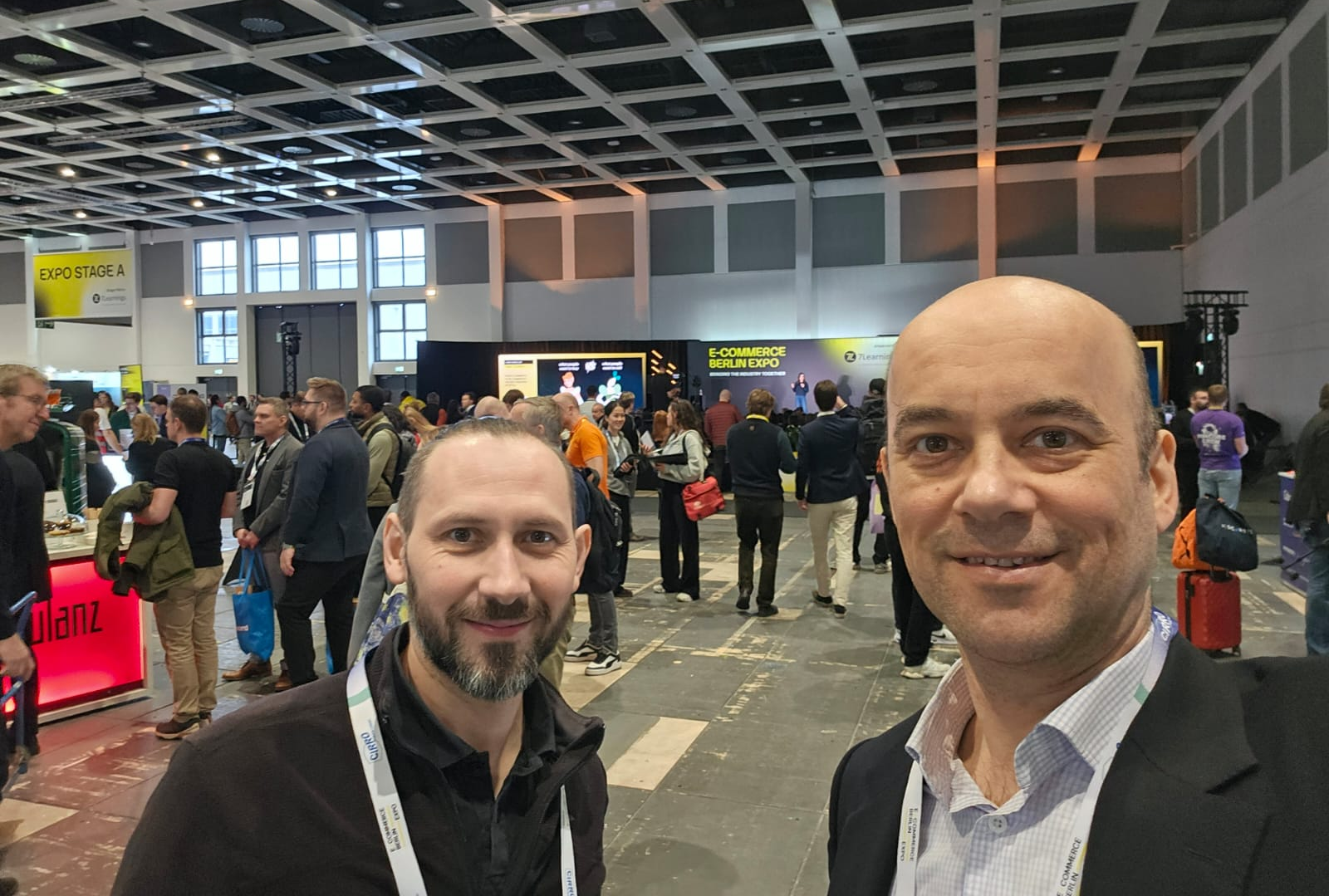


In February 2026, Postis joined the 10th edition of E-commerce Berlin Expo, held for the first time at the prestigious Messe Berlin.
Representing Postis were Cornel Istode, Sales Director, and Alexandru Blaga, Business Sales Executive, who spent two high-impact days connecting with retailers, marketplaces, and technology providers from across Europe.
With over 14,000 participants, 300 exhibitors, and more than 150 speakers across four stages, EBE 2026 confirmed one thing: AI-first commerce is the new operating model.
Building on the strong foundation of previous editions, E-commerce Berlin Expo 2026 highlighted a clear evolution in industry priorities.
The dialogue has expanded from improving individual processes to redesigning commerce ecosystems around AI, automation, and data orchestration.
Retailers are no longer asking only:
Increasingly, they are asking:
For Postis, this shift is highly relevant. It aligns with our long-term vision of logistics orchestration powered by predictive data and intelligent automation.
Artificial Intelligence dominated the agenda across keynotes, panels, and masterclasses, with industry leaders from companies such as: Google, Zalando, TikTok, OTTO; exploring how AI agents, retail media and algorithmic decision-making are transforming commerce.
For logistics, the implications are significant.
As AI accelerates customer journeys and shortens decision cycles, operational infrastructure must become equally responsive. Demand volatility increases. Delivery expectations tighten. Margins remain under pressure.
During discussions with DACH retailers and cross-border brands, several recurring themes emerged:
Precise delivery windows and real-time tracking transparency are baseline expectations.
In an AI-accelerated commerce environment, customers move from discovery to purchase in minutes. That speed reshapes what they expect from delivery. A vague “3–5 business days” estimate no longer aligns with how modern commerce operates.
Retailers are increasingly pressured to provide:
For cross-border retailers in particular, predictability becomes even more complex. Carrier performance varies by region, seasonality affects transit times, and operational bottlenecks can quickly erode margins.
This is where data orchestration becomes critical.
Companies are looking to automate not just warehouse operations, but also:
Retailers want deeper visibility into SLA compliance, cost-per-destination performance, and cross-border efficiency metrics.
Platforms like Postis create measurable value by:
For Postis, the Expo was all about meaningful dialogue.
One question surfaced repeatedly: how do we make our logistics infrastructure ready for AI-first commerce?
The answer lies in unified connectivity and intelligent allocation.
Rather than adding complexity, companies are looking to consolidate systems and gain centralized control. The need is no longer fragmentation, it is orchestration.
Germany remains one of Europe’s most mature and competitive e-commerce markets. Being present at the jubilee edition of EBE reinforced Postis’ commitment to expanding its footprint in the DACH region.
The signals from Berlin were clear:
As commerce becomes more automated, logistics must evolve in parallel.
E-commerce Berlin Expo 2026 confirmed that AI-first commerce is today’s operational reality.
As demand generation becomes smarter and faster, logistics must become predictive, automated, and performance-driven.
Postis continues to invest in:
AI-first commerce requires AI-ready logistics, and Postis is ready.