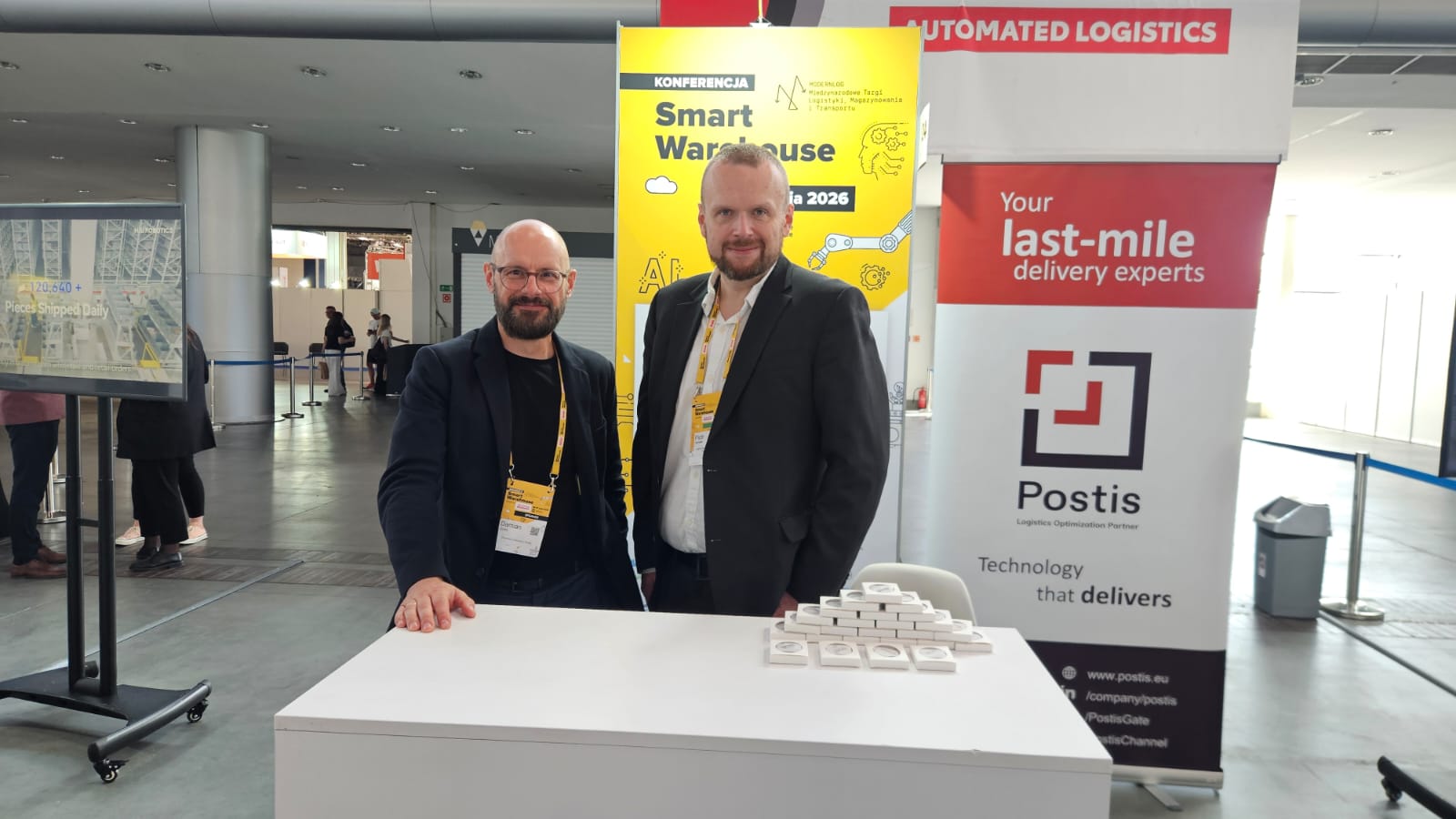


This week, Postis joined Smart Warehouse Community 2026 powered by Toyota Automated Logistics in Poznań as a Silver Partner, represented by Damian Siusta and Piotr Gendek.
As one of Poland’s most important Logistics 4.0 events, Smart Warehouse Community brings together leaders from ecommerce, warehousing, automation, fulfillment, manufacturing, and supply chain operations to discuss how logistics is evolving under growing operational complexity.
What stood out about Smart Warehouse Community was its very practical direction.
The event focused on what actually works in warehouse automation, where companies struggle during implementation, and how logistics teams adapt as complexity grows.
Across the agenda, discussions covered:
Across both days, one theme consistently emerged in presentations, panels, and conversations: operations are becoming increasingly difficult to keep predictable.
More systems are being connected across the same workflows. Delivery expectations continue to rise. Social media platforms are reshaping customer behavior. At the same time, businesses are expected to react faster while maintaining operational visibility and cost control.
Beyond the many valuable conversations during the event, Damian Siusta took part in a panel discussion during which issues relating to effective logistics and the responsibility for delivering on promises made to customers were discussed.
The Polish ecommerce market continues to expand rapidly, supported by increasing cross-border commerce, warehouse investments, and fulfillment network development. Poland is increasingly positioned as a strategic logistics hub connecting Western and Central-Eastern Europe.
This growth creates significant opportunities for retailers, marketplaces, and logistics providers, but it also increases operational pressure.
Businesses are now managing:
One of the main topics closely related to our field of expertise that was discussed at the conference was the growing impact of complex online sales (omnichannel, marketplace platforms, social media platforms) on operational activities. And all this stems from the growing demands of customers who have become accustomed to free and ever-faster deliveries.
Particular attention must be paid to meeting customer expectations in the following areas:
Operational performance increasingly affects commercial performance.
Selling on a marketplace isn’t as easy as some people think. Seller ratings, marketplace visibility, repeat purchase behavior, and customer trust are now directly influenced by delivery execution quality. Delays, failed deliveries, and poor visibility can quickly impact both customer retention and marketplace positioning. Furthermore, rising fees and the need to purchase ad space are forcing many sellers to tread a fine line on their P&L.
Omnichannel logistics also appeared repeatedly throughout the event agenda, especially in discussions around ecommerce, brick and mortar stores and marketplace ecosystems. As retailers operate across more channels simultaneously, fulfillment consistency becomes increasingly difficult to maintain.
Delivery flexibility, inventory visibility, returns handling, and operational coordination now directly influence how customers perceive the overall shopping experience. As a result, logistics is becoming increasingly connected to customer experience, brand perception, and profitability.
Sessions focused on omnichannel logistics and marketplace operations included perspectives from companies such as VTEX, NIVEA, Bricomarché, and Hardis Supply Chain, highlighting how closely fulfillment performance is now connected to customer experience and marketplace competitiveness.
Automation remained one of the central topics during Smart Warehouse Community 2026, and the discussions included perspectives from companies such as Toyota, KNAPP, TGW Logistics, SSI SCHÄFER, Geek+, and Hai Robotics, reflecting how quickly warehouse and fulfillment environments are evolving toward more flexible and scalable operational models.
Industry discussions covered:
Recent developments across the industry continue to show how quickly logistics environments are evolving. Autonomous trucking projects are expanding into real operational testing, while warehouse automation solutions are moving closer to fully autonomous fulfillment models.
Companies are now focused on questions such as:
Several sessions focused specifically on how companies evaluate automation investments in practice:
Companies are also increasingly evaluating automation through adaptability: how quickly systems respond to operational changes, fluctuating volumes, labor shortages, or evolving marketplace expectations.
Topics around AI-supported warehouse management systems, IoT visibility, and supply chain resilience were also explored through workshops and operational discussions led by companies such as Sente and Hardis Supply Chain.
One year after major cyber incidents disrupted retail systems and supply chains across the industry, resilience remains a central concern for logistics and ecommerce leaders.
As systems become more interconnected, disruptions can scale much faster across operations, affecting:
For many companies, visibility across the entire delivery and fulfillment ecosystem is becoming increasingly important.
Businesses are investing more attention into:
This shift reflects a broader industry reality: logistics complexity continues to grow across every stage of the customer journey.
Technology continues to evolve rapidly, but operations still depend heavily on human coordination, adaptability, and operational judgment.
As systems become more advanced, teams are increasingly responsible for managing:
Many speakers highlighted that the future of logistics will depend not only on technology adoption, but also on how effectively organizations combine automation with operational expertise.
On the other hand, there is a growing problem with the availability of staff in the labour market, a point raised by many people during the conference.
Many of the discussions at Smart Warehouse Community reflected the operational challenges Postis consistently sees across ecommerce and retail logistics:
As logistics environments become more interconnected, orchestration is becoming increasingly important across carriers, systems, warehouses, and customer communication flows.
For businesses scaling across markets and channels, maintaining operational clarity is becoming just as important as delivery speed itself.
Smart Warehouse Community 2026 confirmed a broader industry shift already visible across European ecommerce logistics:
Operational complexity is becoming one of the defining challenges of modern logistics.
Automation, AI, increasing customer expectations, and cross-border ecommerce will continue accelerating operational transformation across the industry.
At the same time, visibility, resilience, and operational coordination are becoming critical differentiators for companies managing increasingly connected logistics ecosystems.
For many organizations, the challenge is no longer whether transformation is happening. The challenge is how to manage it effectively at scale.
Let’s talk about how the Postis platform can support your next growth phase.